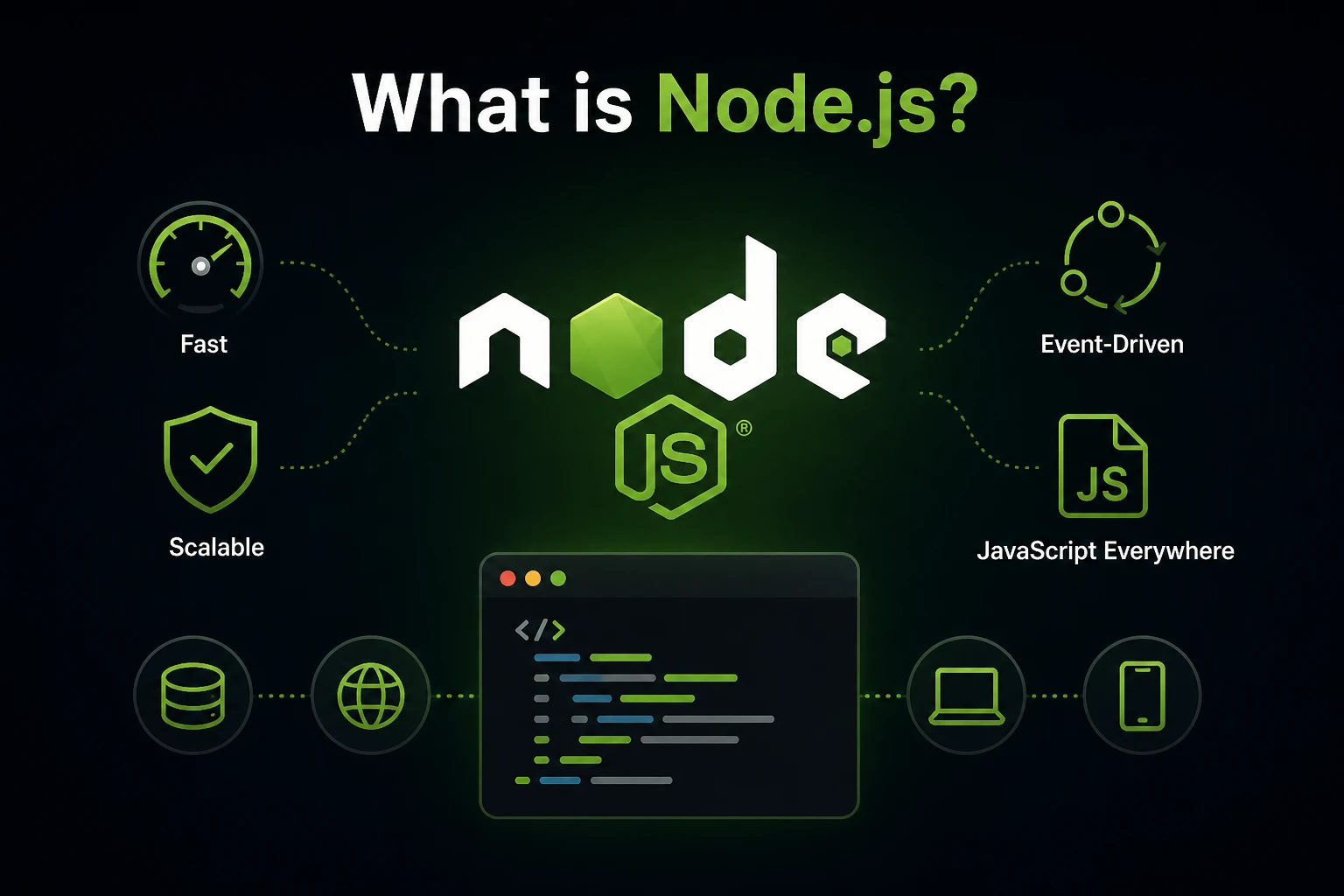
What is Node.js? A Complete Guide for Beginners in 2026
When I first started working with backend technologies, Node.js completely changed how I approached development. Instead of learning a new language for backend, I could use JavaScript everywhere - frontend and backend both. That simplicity is one of the biggest reasons behind its popularity.
In this guide, I’ll explain everything you need to know about Node.js - from basic concepts to how it works internally, and why companies prefer it for building real-world applications.
Table of Contents
- What is Node.js?
- Why Node.js is Popular
- How Node.js Works
- Key Features of Node.js
- Where Node.js is Used
- Node.js Architecture
- Frequently Asked Questions
What is Node.js? Understanding the Basics
Node.js is an open-source runtime environment that allows you to execute JavaScript code outside of a web browser. It is built on Google Chrome's V8 JavaScript engine, which makes it extremely fast and efficient.
Before Node.js, JavaScript was only used in browsers for frontend development. But Node.js changed everything by enabling developers to use JavaScript on the server side as well.
Simple Example to Understand
Think of Node.js as a bridge that connects frontend and backend using the same language. Instead of using different technologies like PHP, Java, or Python for backend, you can now use JavaScript everywhere.
- Frontend → JavaScript (Browser)
- Backend → JavaScript (Node.js)
This reduces complexity and makes development faster and more efficient.
Important Concept
Node.js is not a programming language it's a runtime environment that executes JavaScript outside the browser.
Why Node.js is So Popular Among Developers
Node.js gained massive popularity because it solves real-world problems in web development. It is designed to handle multiple requests efficiently, making it ideal for modern applications.
Fast Performance
Node.js uses the V8 engine, which compiles JavaScript into machine code. This makes execution extremely fast compared to traditional interpreted languages.
Single Language Advantage
You don’t need separate languages for frontend and backend. Everything can be written in JavaScript, which simplifies development and reduces learning time.
Huge Ecosystem (NPM)
Node.js comes with npm (Node Package Manager), which provides thousands of ready-to-use libraries. This saves time and speeds up development.
Scalability
Node.js is built to handle large-scale applications with ease, especially real-time systems like chat apps and live streaming platforms.
Key Benefits of Node.js
- Fast execution with V8 engine
- Handles multiple requests efficiently
- Uses JavaScript everywhere
- Large community and support
- Perfect for real-time applications
How Node.js Works Behind the Scenes
Unlike traditional servers that create a new thread for each request, Node.js uses a single-threaded, event-driven architecture.
Event Loop Concept
Node.js uses an event loop to handle multiple requests asynchronously. Instead of waiting for one task to finish, it continues processing other tasks.
- Non-blocking operations
- Handles thousands of requests simultaneously
- Efficient memory usage
This is why Node.js is extremely fast and suitable for applications that require real-time updates.
Example Scenario
Imagine a server receiving multiple user requests:
- Traditional server → waits for one request to finish
- Node.js → processes all requests simultaneously
This difference makes Node.js much more efficient for modern web apps.
Key Features of Node.js
Asynchronous Programming
Node.js uses asynchronous programming, meaning tasks run in the background without blocking execution.
Non-Blocking I/O
It can handle multiple input/output operations at the same time without slowing down the system.
Lightweight and Fast
Because of its minimal overhead and fast engine, Node.js performs extremely well.
Cross-Platform
Node.js works on Windows, Linux, and macOS without major changes.
Open Source
Being open-source, it has a strong community and continuous improvements.
Quick Summary
- Event-driven architecture
- Non-blocking execution
- Fast and scalable
- JavaScript everywhere
Where Node.js is Used in Real Life
Node.js is widely used in modern applications where speed and real-time interaction are important.
Common Use Cases
- Real-time chat applications
- Streaming services
- REST APIs
- Online gaming servers
- E-commerce platforms
Many large-scale applications rely on Node.js because it can handle millions of users efficiently.
Node.js Architecture Explained
The architecture of Node.js is based on a single-threaded event loop combined with background workers.
Main Components
- Event Loop → handles all requests
- Callback Queue → stores tasks
- Thread Pool → handles heavy operations
This architecture ensures high performance without creating multiple threads.
Why This Architecture Matters
Because of this design, Node.js can:
- Handle high traffic efficiently
- Reduce server load
- Improve response time
Conclusion: Should You Learn Node.js?
If you're serious about becoming a full stack developer, learning Node.js is a smart move. It simplifies development, improves performance, and opens up many career opportunities.
From startups to large companies, Node.js is widely used because it delivers speed, scalability, and flexibility.
About the Author
Ankit Singh is a full stack developer with hands-on experience in building scalable web applications using Node.js, React, and modern backend technologies.
He focuses on writing clean, efficient code and helping developers understand complex concepts in a simple and practical way.